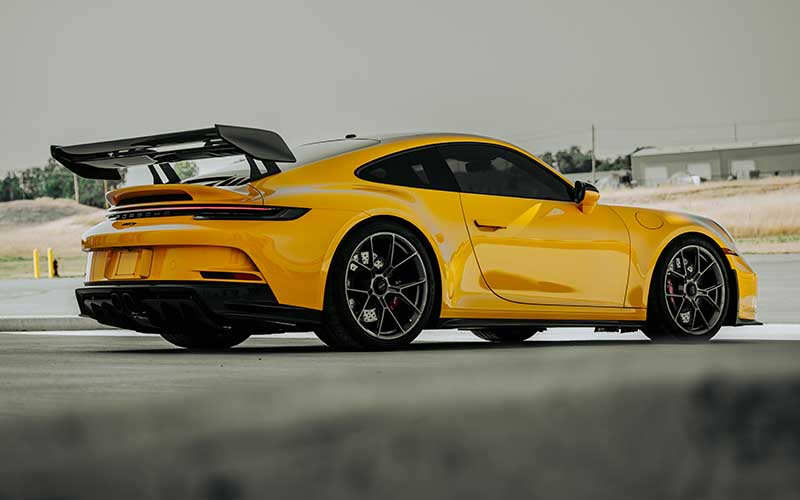
Few automotive manufacturers have developed such a distinctive engine heritage as Porsche. From compact four-cylinder engines to high-revving V10s, Porsche has repeatedly explored different cylinder configurations while maintaining a strong focus on performance, efficiency, and motorsport. Each engine type has played a different role in Porsche’s history, and together they tell the story of how the company evolved from a small sports-car manufacturer into one of the world’s most respected performance brands.
Four-Cylinder Engines: Small but Significant
Porsche’s relationship with four-cylinder engines goes back to the company’s earliest sports cars. The Porsche 356 used a rear-mounted, air-cooled flat-four derived from the Volkswagen engine designed by Ferdinand Porsche. Although relatively small by modern standards, these engines established an important Porsche principle: performance does not necessarily require a large displacement.
The flat-four configuration, with two cylinders on each side of the crankshaft, offered a low center of gravity and compact dimensions. Over the years, Porsche developed increasingly sophisticated versions of the concept. The four-cylinder engine also became important in Porsche’s motorsport activities.
In modern times, the four-cylinder returned to prominence with the 718 Cayman and Boxster. Turbocharged flat-four engines provided strong torque and impressive efficiency while keeping weight relatively low. Although some enthusiasts initially missed the sound of Porsche’s naturally aspirated six-cylinder engines, the modern flat-four demonstrated how turbocharging could deliver serious performance from a compact package.
Six-Cylinder Engines: Porsche’s Signature Configuration
If one engine configuration can be considered synonymous with Porsche, it is the flat-six. The company’s six-cylinder boxer engines became famous through the 911, beginning with the original 911 in the 1960s.
A flat-six places three cylinders on each side of the crankshaft. This arrangement provides excellent mechanical balance and allows the engine to sit low in the chassis. In the rear-engined 911, that low height is particularly valuable because it helps keep the vehicle’s center of gravity down.
Porsche developed the flat-six through generations of technological change. Early engines were air-cooled, while later versions adopted water cooling. Turbocharging, variable valve timing, direct fuel injection, and advanced engine management systems progressively increased both power and efficiency.
The character of the flat-six is equally important. Its distinctive sound, compact design, and ability to produce power at high engine speeds have become central elements of the 911 experience. From naturally aspirated racing engines to modern twin-turbocharged units, Porsche’s flat-six remains one of the most recognizable performance engines in the world.
Eight-Cylinder Engines: From Racing to Luxury Performance
Porsche has also produced a fascinating range of eight-cylinder engines. Unlike the flat-four and flat-six configurations most strongly associated with the company, Porsche’s V8 engines have generally been used where greater displacement, torque, and versatility were required.
Porsche’s racing history includes remarkable eight-cylinder engines, most famously the flat-eight used in cars such as the Porsche 908. The 908’s horizontally opposed eight-cylinder engine was developed for endurance racing and demonstrated Porsche’s ability to build highly specialized competition engines.
Later, Porsche increasingly used V8 engines in road cars. Models such as the 928 featured a front-mounted V8, while V8 power became particularly important in Porsche’s larger performance and luxury vehicles. The Cayenne and Panamera have also used various V8 engines, combining substantial power with the torque needed for larger vehicles.
The V8 therefore represents a different side of Porsche engineering. Whereas the flat-six is closely associated with lightweight sports cars and the 911, the V8 has allowed Porsche to compete in segments where effortless torque, refinement, and high-speed performance are priorities.
Ten-Cylinder Engines: The Extraordinary Carrera GT
Porsche’s ten-cylinder engine is perhaps the most exotic of all. The company produced a V10 for the legendary Carrera GT, introduced in the early 2000s.
The Carrera GT’s 5.7-liter naturally aspirated V10 was heavily influenced by Porsche’s motorsport engineering. It was designed to deliver extraordinary performance without relying on turbocharging. The engine could rev to around 8,000 rpm and produced an unforgettable high-pitched soundtrack as it approached its redline.
The V10 configuration gave Porsche an opportunity to combine the smoothness of a multi-cylinder engine with the character of a high-revving racing motor. Paired with a six-speed manual transmission and a lightweight construction philosophy, the Carrera GT became one of Porsche’s most celebrated supercars.
Unlike Porsche’s four-, six-, and eight-cylinder engines, the V10 was never intended to become a mainstream configuration within the company’s road-car range. Its rarity is part of what makes the Carrera GT and its engine so special.
Four, Six, Eight, or Ten?
Each Porsche engine configuration represents a different engineering philosophy. The four-cylinder demonstrates efficiency and compactness; the six-cylinder embodies Porsche’s sports-car identity; the eight-cylinder delivers power and torque for larger performance applications; and the ten-cylinder represents an uncompromising approach to high-performance engineering.
What connects them is Porsche’s willingness to refine each configuration rather than simply chase cylinder count. The company has repeatedly shown that performance depends on much more than displacement or the number of cylinders. Weight, balance, induction, engine speed, thermal management, and the relationship between the engine and chassis are equally important.
From the modest flat-four of the early 356 to the extraordinary V10 of the Carrera GT, Porsche’s engine history is therefore a story of experimentation and engineering evolution. While the six-cylinder boxer remains the company’s defining powerplant, its four-, eight-, and ten-cylinder engines have each contributed important chapters to the Porsche story.